
The Impact
Bipolar I disorder is a treatable medical condition that can cause extreme shifts in mood, thoughts, energy, and behavior. Its impact can reach beyond those living with it, affecting loved ones, too.

A prescription medicine used for the acute treatment of manic or mixed episodes associated with bipolar I disorder in adults.
Learn MoreBipolar I disorder is a treatable medical condition that can cause extreme shifts in mood, thoughts, energy, and behavior. Its impact can reach beyond those living with it, affecting loved ones, too.
A person’s mood can shift between the two “poles” of bipolar I disorder: mania, characterized by elevated or irritable mood and increased energy, and depression. These episodes can last anywhere from days to months.
During manic episodes, elevated or irritable mood and increased energy levels can significantly interfere with a person’s physical, cognitive, and social functioning, making bipolar I disorder especially challenging to manage.
Bipolar disorder does not have a single known cause. Research suggests that brain chemistry and other factors may play a role.
While no one fully understands why some people experience bipolar mania—9.6 million Americans do—you are not alone. Support and treatment options are available.

Symptoms of a manic episode include inflated self-esteem, decreased need for sleep, pressured speech, racing thoughts, distractibility, psychomotor agitation and risky behavior.

Right now, there is no cure for bipolar I disorder, but it is treatable. Many people successfully manage their condition through a combination of medications, counseling and a support system.

A diagnosis does not change who you are. Bipolar I disorder may be part of your health journey, but it does not define you.
BYSANTI™ is proven to treat the symptoms of bipolar mania. Talk with your healthcare professional about whether BYSANTI™ may be right for you.
BYSANTI™ is a prescription medicine used for the acute treatment of manic or mixed episodes associated with bipolar I disorder in adults.

With your healthcare professional's guidance, you will start BYSANTI™ at a lower dose and gradually increase it over a few days to help your body adjust.
Starting low and increasing your dose slowly may help avoid lightheadedness or faintness. Lightheadedness or faintness may occur when standing up or getting up too quickly due to changes in heart rate and blood pressure (orthostatic hypotension).
BYSANTI™ needs to be taken as directed. Swallow the tablets whole, with or without food.
Keep taking BYSANTI™ as prescribed, even if you start to feel better, unless your healthcare professional tells you otherwise.
Link your medication to a daily routine and keep it somewhere visible to make it easy to remember.
Set an alarm on your phone, clock or watch when it's time to take your dose.
Mark a calendar or journal each time you take your medication so you always have a clear record of your doses.
A pill organizer makes it easy to see at a glance whether you've taken your dose for the day.
Ask a family member or friend to check in with you daily and remind you when it's time to take your medication.
Start each day with two rubber bands on your wrist and remove one after each dose, a simple visual cue to stay on track.

While you're taking BYSANTI™, always check with your healthcare professional before starting any new prescription or over-the-counter medicines you can get without a prescription, including any supplements.
Some medicines may be unsafe to use when taking BYSANTI™. Some medicines can affect how well BYSANTI™ works.
When taking BYSANTI™, you should avoid drinking alcohol, and you should not breastfeed.
Tell your healthcare professional if you become pregnant or intend to become pregnant while taking BYSANTI™. BYSANTI™ may cause extrapyramidal (abnormal involuntary movements) and/or withdrawal symptoms in newborn babies exposed to BYSANTI™ during the third trimester.
BYSANTI™ has not been studied in children and teenagers younger than 18 years.
Your healthcare professional will consider several factors when deciding if a medication is right for you, including your symptoms, current health conditions, and other medications you may be taking.
Side effects can vary from person to person, so it’s important to work with your healthcare professional.
Common side effects for BYSANTI™ in people with bipolar I disorder include:
Iloperidone and milsaperidone (the active ingredient in BYSANTI™) rapidly convert into one another in the body.
If you experience any side effects that concern you, talk to your healthcare professional right away.
Learn about bipolar I disorder, BYSANTI™ treatment and dosing, and tips for staying on track.
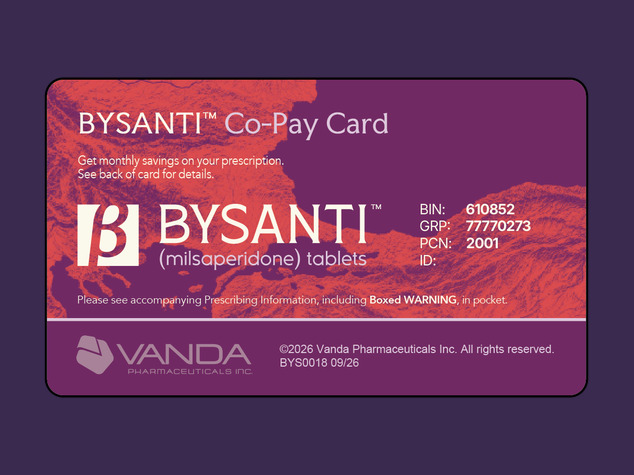
Learn about co-pay eligibility and ways to save on your BYSANTI™ prescription.
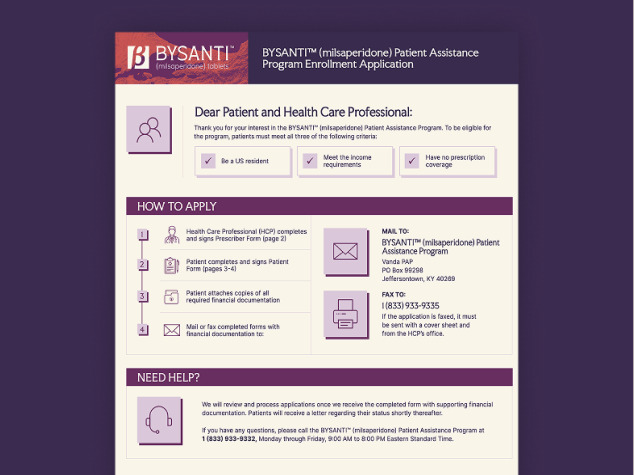
Learn about support options and assistance that may be available with BYSANTI™.
Important Safety
Information and Indications
Important Safety Information:
Elderly patients with psychosis related to dementia (having lost touch with reality due to memory loss and experiencing a decline in day-to-day functioning) who are treated with antipsychotic medications are at an increased risk of death compared to patients treated with a placebo. BYSANTI™ is not approved for use in people with dementia-related psychosis.
BYSANTI™ (milsaperidone) is a prescription medication used for the treatment of schizophrenia and the acute treatment of manic or mixed episodes associated with bipolar I disorder in adults.
Elderly patients with psychosis related to dementia (having lost touch with reality due to memory loss and experiencing a decline in day-to-day functioning) who are treated with antipsychotic medications are at an increased risk of death compared to patients treated with a placebo. BYSANTI™ is not approved for use in people with dementia-related psychosis.
Patients should not use BYSANTI™ if they have a known allergy to BYSANTI™ or its ingredients. Allergic reactions, including anaphylaxis, rapid swelling of the skin (angioedema) and other symptoms of allergy (e.g., throat tightness; swelling of the throat, face, lips, mouth and tongue; hives; rash and itching) have been reported.
The most common side effects for BYSANTI™ versus placebo in patients with schizophrenia were dizziness, dry mouth, feeling unusually tired or sleepy, stuffy nose, feeling faint/light-headed when standing quickly, racing heartbeat and weight gain. The most common side effects for BYSANTI™ versus placebo in a clinical study of patients with bipolar I disorder were racing heartbeat, dizziness, dry mouth, increase in liver enzymes, stuffy nose, weight gain, low blood pressure and feeling unusually tired or sleepy. Compared to placebo, the average weight gain in clinical studies in schizophrenia lasting 4 to 6 weeks was 6 pounds and in a clinical study of patients with bipolar I disorder over 4 weeks was 7 pounds. If you experience any of these symptoms, talk with your healthcare provider.
When taking BYSANTI™, you should avoid drinking alcohol and you should not breastfeed.
You should notify your healthcare provider if you become pregnant or intend to become pregnant while taking BYSANTI™.
Tell your healthcare provider about any medical conditions that you have, including problems with your liver. BYSANTI™ is not recommended for patients with severe liver problems.
Tell your healthcare provider about all prescription and non-prescription medicines and supplements you are taking. Some medications may interact with BYSANTI™.
Your healthcare provider may recommend a genetic test before starting BYSANTI™ to see how your body processes the medication, as this can affect the right dose for you. People who process it slowly (poor metabolizers) may need a different dosing schedule.
If you take certain other medications that can affect how BYSANTI™ works in your body (such as strong inhibitors of CYP2D6 or CYP3A4), your healthcare provider may need to lower your dose. Always tell your healthcare provider about all medicines you're taking to avoid interactions.
To access the full Prescribing Information, including BOXED WARNING, visit www.bysanti.com.
You are encouraged to report negative side effects of prescription drugs to the FDA. Visit www.fda.gov/medwatch or call 1-800-FDA-1088.